

Author: admin
The Global AGE Inhibitors Market is spurred by rising diabetes and aging populations, increasing demand for therapies to prevent complications like diabetic nephropathy. Key opportunities include developing anti-aging skincare, functional foods, and nutraceuticals, despite challenges in clinical trial success rates.
Dublin, Jan. 26, 2026 (GLOBE NEWSWIRE) — The “Advanced Glycation End Products Inhibitors Market – Global Industry Size, Share, Trends, Opportunity, and Forecast, 2021-2031” has been added to ResearchAndMarkets.com’s offering.
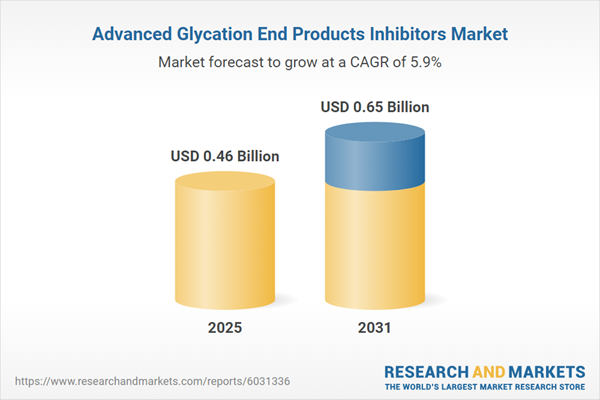
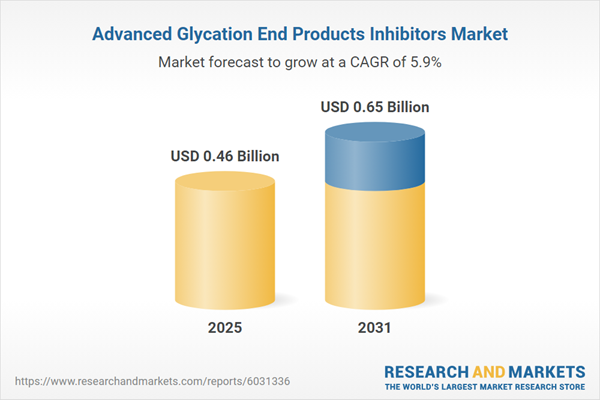
The Global Advanced Glycation End-Products (AGE) Inhibitors Market is projected to expand from USD 0.46 Billion in 2025 to USD 0.65 Billion by 2031, reflecting a compound annual growth rate of 5.93%
These inhibitors are specialized therapeutic agents designed to obstruct the non-enzymatic crosslinking of sugars and proteins, a process that contributes to tissue damage in chronic diseases. The market’s growth is largely driven by the rising incidence of aging-related conditions and metabolic disorders, such as diabetic nephropathy, which necessitate effective management. According to the International Diabetes Federation, approximately 589 million adults aged 20 to 79 were living with diabetes globally in 2024, highlighting the critical need for interventions that reduce complications caused by glycation.
However, the industry faces significant hurdles regarding the clinical translation of these therapeutics. Historically, many potential candidates have failed to demonstrate adequate safety or efficacy during late-stage human trials, resulting in strict regulatory oversight. This high attrition rate in drug development creates substantial financial risk and serves as a primary obstacle, delaying the rapid commercialization and widespread availability of novel inhibitors within this therapeutic category.
Market Drivers
The increasing prevalence of diabetes and its associated microvascular complications acts as a primary catalyst for the Global Advanced Glycation End-Products (AGE) Inhibitors Market. High blood sugar levels accelerate the non-enzymatic glycation of proteins, causing the accumulation of AGEs which are central to the development of severe conditions like diabetic nephropathy. A November 2024 analysis by The Lancet revealed that the global number of adults with diabetes has surpassed 800 million, a fourfold increase since 1990, creating an urgent clinical necessity for inhibitors to prevent organ damage. Additionally, the Centers for Disease Control and Prevention estimated in 2024 that 35.5 million adults in the United States suffer from chronic kidney disease, a condition often exacerbated by AGEs, further fueling demand.
Market growth is further propelled by the rapidly expanding global geriatric population, which is highly susceptible to age-related pathologies where AGE accumulation serves as a key biological marker of senescence. As tissues age, their ability to replace glycated proteins diminishes, leading to vascular stiffening and reduced elasticity that requires pharmacological intervention. According to the United Nations’ “World Population Prospects 2024” report from July 2024, global life expectancy at birth reached 73.3 years, effectively extending the period during which glycation disorders can manifest. Consequently, pharmaceutical companies are increasingly adjusting their research and development pipelines to meet the chronic management needs associated with longer lifespans.
Market Challenges
A major obstacle hampering the growth of the Global Advanced Glycation End-Products (AGE) Inhibitors Market is the high rate of attrition in clinical trials, which generates financial uncertainty and delays commercialization. The development of new therapeutics for metabolic and aging-related diseases is notably complex, frequently resulting in candidates failing to meet efficacy endpoints in late-stage studies. This unpredictability discourages pharmaceutical firms from investing heavily in AGE inhibitor research, as the potential return on investment is often difficult to justify against the soaring costs of development, thereby stagnating the pipeline and limiting market expansion.
This challenge is underscored by recent industry statistics that reveal the precarious nature of drug discovery. Data from the Biotechnology Innovation Organization in 2024 indicated that the overall clinical development success rate for investigational drugs fell to just 6.7%. Such a low probability of success highlights the immense risks developers face when pursuing novel mechanisms like AGE inhibition. When stakeholders perceive an asset class as having a high potential for failure, capital inflows decrease, significantly slowing the pace of innovation within the sector.
Market Trends
The integration of AGE inhibitors into anti-aging skincare and cosmeceuticals is fundamentally transforming the market by shifting these agents from clinical diabetic treatments to high-demand consumer beauty products. Cosmetic manufacturers are aggressively developing topical formulations that target the Maillard reaction to prevent the cross-linking of collagen fibers, which leads to skin yellowing and loss of elasticity. For instance, L’Oreal reported in its “2024 Annual Results” in February 2025 that it invested over €1.3 billion in Research & Innovation, emphasizing the significant financial resources now dedicated to developing biological mechanisms, including anti-glycation technologies, to meet consumer demand for skin longevity solutions.
Simultaneously, the rise of AGE-targeting functional foods and nutraceuticals represents a strategic pivot toward preventive metabolic management through diet. As consumers increasingly view diet as a primary tool for longevity, manufacturers are fortifying products with natural AGE inhibitors, such as polyphenols and flavonoids, to mitigate systemic glycation stress before chronic diseases appear. This trend is amplified by the broader “food as medicine” movement; according to the Institute of Food Technologists’ April 2025 report, retail sales of healthy food and beverages in the United States reached $320 billion in 2024, underscoring the vast market potential for functional formulations designed to counteract metabolic aging processes.
Report Scope
Key Players Profiled in the Advanced Glycation End-Products (AGE) Inhibitors Market
- DSM
- BASF
- Lonza
- Heel
- Clinicians & Small Biotechs
- Sanofi
- Pfizer
- GSK
- TSI Group
- Academic Spinouts
Advanced Glycation End-Products (AGE) Inhibitors Market, by Drug:
- Carnosine
- Pyridoxine
- Agmatine
- Benfotiamine
- Alpha Lipoic Acid
- Others
Advanced Glycation End-Products (AGE) Inhibitors Market, by Indication:
- Metabolic Diseases
- Cardiovascular Diseases
- Degenerative Diseases
- Others
Advanced Glycation End-Products (AGE) Inhibitors Market, by Distribution Channel:
- Hospital Pharmacies
- Drug Stores & Retail Pharmacies
- Online Pharmacies
Advanced Glycation End-Products (AGE) Inhibitors Market, by Region:
- North America
- Europe
- Asia-Pacific
- South America
- Middle East & Africa
Key Attributes:
| Report Attribute | Details |
| No. of Pages | 180 |
| Forecast Period | 2025 – 2031 |
| Estimated Market Value (USD) in 2025 | $0.46 Billion |
| Forecasted Market Value (USD) by 2031 | $0.65 Billion |
| Compound Annual Growth Rate | 5.9% |
| Regions Covered | Global |
For more information about this report visit https://www.researchandmarkets.com/r/8qp158
About ResearchAndMarkets.com
ResearchAndMarkets.com is the world’s leading source for international market research reports and market data. We provide you with the latest data on international and regional markets, key industries, the top companies, new products and the latest trends.
Attachment
CONTACT:
CONTACT: ResearchAndMarkets.com
         Laura Wood,Senior Press Manager
         press@researchandmarkets.com
         For E.S.T Office Hours Call 1-917-300-0470
         For U.S./ CAN Toll Free Call 1-800-526-8630
         For GMT Office Hours Call +353-1-416-8900

Đề xuất
Reed Smith LLP Announces Proposed Settlement of In re The Beauty Health Company Consolidated Stockholder Litigation
Dermalogic Laser Center Launches New, Upgraded Website
Toll Brothers Announces New Luxury Home Community, Piney Trail Estates, is Coming Soon to Parker, Colorado
Gymboree and Marchesa Introduce MARCHESA MINI X GYMBOREE, a Collection of Elevated Occasion-Wear
Prepared and Aware: 4 Travel Safety Tips for Your 2026 Getaway
Organic Personal Care Products Market Size to Hit USD 63.63 Billion by 2035 | Research by SNS Insider