

Author: admin
The Vitamin C Serum Market is driven by an aging demographic seeking non-invasive anti-aging skincare solutions, emphasizing clinically validated products over luxury marketing. Key opportunities lie in developing stable, synergistic formulations and clean, organic products to meet growing consumer demand despite stability challenges.
Dublin, Jan. 26, 2026 (GLOBE NEWSWIRE) — The “Vitamin C Serum Market – Global Industry Size, Share, Trends, Opportunity, and Forecast, 2021-2031” has been added to ResearchAndMarkets.com’s offering.

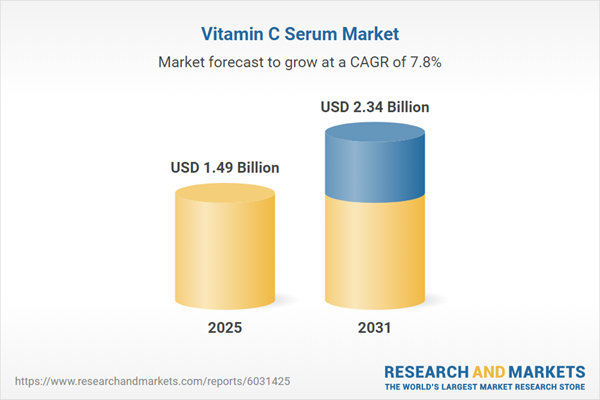
The Global Vitamin C Serum Market is projected to expand from USD 1.49 Billion in 2025 to USD 2.34 Billion by 2031, reflecting a compound annual growth rate of 7.81%
Growth is primarily underpinned by demographic shifts toward an aging population seeking non-invasive anti-aging solutions and a broader structural change in consumer behavior that favors clinically proven dermatological health over superficial cosmetic claims. These fundamental drivers ensure that active-ingredient products remain a staple in skincare routines rather than passing trends.
According to Cosmetics Europe, the skincare category expanded by 6.6% during the previous year, maintaining its dominance with retail sales totaling €30.1 billion in 2025. Despite this robust financial performance, the market faces significant hurdles regarding product stability, specifically the rapid oxidation of Vitamin C when exposed to air and light. This chemical volatility affects shelf life and effectiveness, creating a technical barrier that challenges product longevity and threatens to undermine consumer confidence and broader market adoption.
Market Drivers
The market is being significantly reshaped by a heightened emphasis on dermatologist-recommended skincare, as consumers increasingly value clinical validation over traditional luxury marketing. This shift has elevated science-backed formulations, with Vitamin C recognized as a key active ingredient for correcting photodamage and enhancing collagen synthesis. In response, manufacturers are heavily investing in clinical trials and highlighting medical credentials to prove product potency. The commercial success of this approach is reflected in the strong performance of dermocosmetic brands; for instance, Beiersdorf’s ‘Annual Report 2024’, released in March 2025, noted that their dermatological portfolio, including Eucerin and Aquaphor, achieved 10.6% organic sales growth, illustrating the strong demand for trusted, health-focused skincare.
Concurrently, the growing demand for clean and organic beauty is fueling the creation of transparent, stable, and naturally derived Vitamin C products. Shoppers are closely examining ingredient lists, driving the rise of “clean clinical” hybrids that merge efficacy with non-toxic safety standards. This aligns with a broader industry trend toward wellness; Unilever’s ‘Full Year 2024 Results’ in February 2025 reported a 6.5% underlying sales growth in their Beauty & Wellbeing division. This preference is further highlighted by consumer sentiment data from Klarna’s ‘Beauty Report 2025’, published in October 2025, which found that 36.3% of consumers explicitly prioritize organic beauty, compelling brands to innovate with bio-fermented and plant-based sources.
Market Challenges
The most significant obstacle facing the Global Vitamin C Serum Market is the inherent chemical instability of L-ascorbic acid. When exposed to environmental stressors like light, oxygen, or heat, this active ingredient rapidly oxidizes, degrading into an ineffective substance that frequently causes discoloration and skin irritation. This volatility compels manufacturers to enforce strict, costly supply chain protocols and reduces the commercially viable shelf life of their inventory. As a result, brands incur higher costs associated with product spoilage and increased return rates, which directly undermines profit margins and operational efficiency.
The financial implications of this technical barrier are intensified by the sector’s rapid growth, which complicates quality control at scale. According to the Cosmetic, Toiletry and Perfumery Association, skincare sales in Great Britain rose by 12.2% in 2024. As consumer demand accelerates at this pace, the difficulty of guaranteeing formulation stability in larger production batches threatens to impede progress. When customers receive oxidized or ineffective products, the immediate loss of trust creates a lasting deficit in brand loyalty, hindering consistent market capitalization despite strong consumer interest.
Market Trends
Product development is being fundamentally transformed by the rise of synergistic multi-active formulations, as manufacturers transition from single-ingredient serums to hybrid blends that enhance Vitamin C’s effectiveness through chemical pairing. Brands are increasingly combining Vitamin C with complementary actives such as ferulic acid and vitamin E to improve photoprotection, or with peptides to simultaneously support collagen synthesis and barrier repair. This trend highlights a consumer shift toward high-performance, multitasking solutions; L’Oreal’s ‘2024 Half-Year Results’ from July 2024 revealed that their Dermatological Beauty division, featuring brands like SkinCeuticals and CeraVe, posted 16.4% like-for-like sales growth, confirming the market’s pivot toward complex, clinically proven products.
Simultaneously, the industry is adopting next-generation stabilized derivatives to address pervasive oxidation issues, allowing brands to replace volatile L-ascorbic acid with robust alternatives such as Tetrahexyldecyl Ascorbate. These oil-soluble, shelf-stable variants facilitate wider distribution without the logistical risks of rapid spoilage and reduce the skin irritation often linked to traditional low-pH formulas.
This technological advancement is fueling growth in the masstige segment by making potent brightening treatments more accessible and reliable. Highlighting this momentum, The Estee Lauder Companies reported in their August 2024 ‘Fiscal 2024 Results’ that The Ordinary achieved strong double-digit global net sales growth, driven largely by demand for ingredient-led lines utilizing these advanced stable technologies.
Report Scope
Key Players Profiled in the Vitamin C Serum Market:
- L’Oreal S.A.
- The Procter & Gamble Company
- Unilever PLC
- The Estee Lauder Companies, Inc.
- Shiseido Company, Limited
- Beiersdorf AG
- Amorepacific Corporation
- Galderma S.A.
- Clarins Group
- KOSe Corporation
Vitamin C Serum Market, by Product Type:
- Below 10%
- 10% to 20%
- 20% & Above
Vitamin C Serum Market, by Sales Channel:
- Supermarket/Hypermarket
- Specialty Stores
- Online
- Others
Vitamin C Serum Market, by Region:
- North America
- Europe
- Asia-Pacific
- South America
- Middle East & Africa
Key Attributes:
| Report Attribute | Details |
| No. of Pages | 180 |
| Forecast Period | 2025 – 2031 |
| Estimated Market Value (USD) in 2025 | $1.49 Billion |
| Forecasted Market Value (USD) by 2031 | $2.34 Billion |
| Compound Annual Growth Rate | 7.8% |
| Regions Covered | Global |
For more information about this report visit https://www.researchandmarkets.com/r/tcz5sj
About ResearchAndMarkets.com
ResearchAndMarkets.com is the world’s leading source for international market research reports and market data. We provide you with the latest data on international and regional markets, key industries, the top companies, new products and the latest trends.
Attachment
CONTACT:
CONTACT: ResearchAndMarkets.com
         Laura Wood,Senior Press Manager
         press@researchandmarkets.com
         For E.S.T Office Hours Call 1-917-300-0470
         For U.S./ CAN Toll Free Call 1-800-526-8630
         For GMT Office Hours Call +353-1-416-8900

Đề xuất
Reed Smith LLP Announces Proposed Settlement of In re The Beauty Health Company Consolidated Stockholder Litigation
Dermalogic Laser Center Launches New, Upgraded Website
Toll Brothers Announces New Luxury Home Community, Piney Trail Estates, is Coming Soon to Parker, Colorado
Gymboree and Marchesa Introduce MARCHESA MINI X GYMBOREE, a Collection of Elevated Occasion-Wear
Prepared and Aware: 4 Travel Safety Tips for Your 2026 Getaway
Organic Personal Care Products Market Size to Hit USD 63.63 Billion by 2035 | Research by SNS Insider