

Author: admin
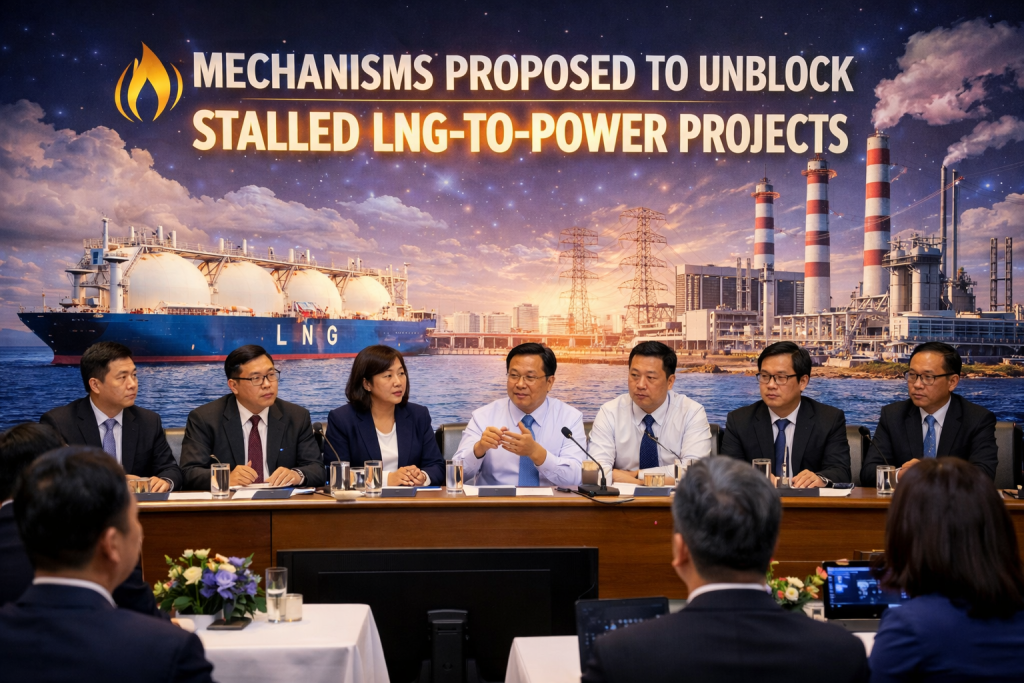
The core of a newly drafted Decree by the Ministry of Industry and Trade (MoIT) centers on output commitment mechanisms and electricity pricing, aiming to pave the way for the development of imported Liquefied Natural Gas (LNG) projects in the coming phase.
Two Proposed Power Purchase Options
The MoIT has submitted two options for the Government’s consideration and final decision. Option 1: MoIT proposes increasing the minimum long-term contract output (Qc) from 65% to 75% of the project’s average multi-year generation. It also suggests extending the application period from 10 years to 15 years. This would apply to imported LNG projects commissioned from the effective date of Electricity Law No. 61/2024/QH15 until January 1, 2031. While this option provides stability for investors and facilitates capital mobilization, it carries the risk of committing to output far exceeding actual demand, potentially driving up power purchase costs and reducing overall system efficiency.
Option 2: This option maintains the minimum long-term contract output at the current 65% but integrates a supplementary electricity market mechanism. The MoIT is currently reviewing the overall market design to introduce specific support mechanisms for imported LNG. This includes a two-component pricing mechanism including an energy price via the spot market and a capacity price via the Capacity Adequacy Mechanism (CAM). Another proposed support is changing the Best New Entrant (BNE) reference plant from coal-fired to LNG-fired thermal power.
The MoIT noted that maintaining the 65% level aligns with the spirit of Resolutions No. 68-NQ/TW and 70-NQ/TW, where the state creates an enabling environment for the private sector without administrative interference in market principles. This option also adheres to Government directives that EVN and investors should negotiate Power Purchase Agreements (PPAs) independently, without “involving the Government in international commitments.”
Proposal for Full LNG Cost Pass-Through into Power Prices
Practical cost realities further justify maintaining the 65% threshold, as imported LNG power prices are significantly higher than traditional and renewable sources.
Specifically, the maximum price in the 2025 bracket for LNG-to-power is nearly 3,330 VND/kWh. In contrast, the average production cost for coal-fired power in 2024 was less than 2,000 VND/kWh, domestic gas-fired power stood at 1,940 VND/kWh, and solar power was nearly 1,990 VND/kWh.
In the price structure of imported LNG projects, the fixed price component (linked to investment costs, debt service, capital recovery, and O&M) accounts for only a small portion. The majority is the energy price component, which is tied directly to the cost of imported LNG fuel.
Therefore, the MoIT determined that increasing the minimum Qc primarily meets the demands of LNG producers and suppliers (imported using foreign currency). Additionally, the trend of increasing renewable energy proportions and the development of Battery Energy Storage Systems (BESS) means the actual mobilization of baseload sources tends to decrease. If high outputs (e.g., above 75%) are committed, EVN will have to pay significant costs for LNG power even if it is not heavily mobilized, increasing purchase prices and reducing system efficiency.
Amidst electricity demand growing faster than GDP, the power system must meet growth targets while ensuring energy security and transitioning to clean energy. Imported LNG is viewed as a supplementary solution, especially when renewable energy generation declines. However, high costs and financial risks have caused difficulties for many projects. In reality, PV Power has yet to convince authorities of the feasibility of high output commitment mechanisms when actual mobilization demand from the system tends to decrease.
Beyond the two options mentioned, PV Power also petitioned the MoIT to consider a mechanism for the direct pass-through of imported LNG fuel costs into electricity prices. According to the enterprise, taxes, fees, and costs arising from each imported LNG shipment are fully documented with invoices and payment vouchers, and thus should be calculated correctly and fully in the electricity price.
Based on Accounting Standard No. 02 and the provisions in Article 25 of Circular 200/2014/TT-BCT, the original price of raw materials includes the purchase price on the invoice, import tax, special consumption tax, along with customs, inspection, and SBLC opening fees. Therefore, these taxes and fees constitute the imported LNG price and need to be included in the electricity price payment mechanism.
However, to date, EVN/EPTC has not agreed to include these items in the electricity price due to a lack of specific guidance from competent authorities. Consequently, PV Power requested the Group to report to the MoIT and the Government to soon issue detailed regulations.
PV Power (Petrovietnam)—which has commissioned Nhon Trach 3 and Nhon Trach 4, the first two imported LNG plants—proposed adjusting mechanisms to ensure debt repayment capabilities, adding guidance for fuel price pass-through, resolving obstacles regarding LNG storage and distribution fees, and extending the incentive mechanism period beyond the January 1, 2031 milestone to reduce the risk of progress delays. According to Petrovietnam, without these adjustments, LNG projects face the risk of not being mobilized for generation, affecting debt repayment and eroding policy confidence.
Đề xuất
ASEAN SHOP 2027: Southeast Asia’s Premier Smart Retail & Vending Exhibition Returns to Bangkok
MIT CTL and Mecalux Launch Executive Programme on AI for Supply Chain Decision-Making
Solutions for Localizing AI
Asia Coffee Shop Supply Chain Exhibition 2027: Connecting the Entire Coffee Industry Value Chain
Rising Youth Sports Participation Strengthens the Global Pitching Machine Market
Global RPA & Hyper Automation Market Expands as Businesses Prioritize Operational Efficiency