

Author: admin
In the 2022-2024 period, Japanese non-manufacturing businesses invested 886 billion yen in Vietnam. This figure accounts for 69% of the total investment by Japanese enterprises, an increase from 64% in the preceding three years and 44% in the 2016-2018 period.
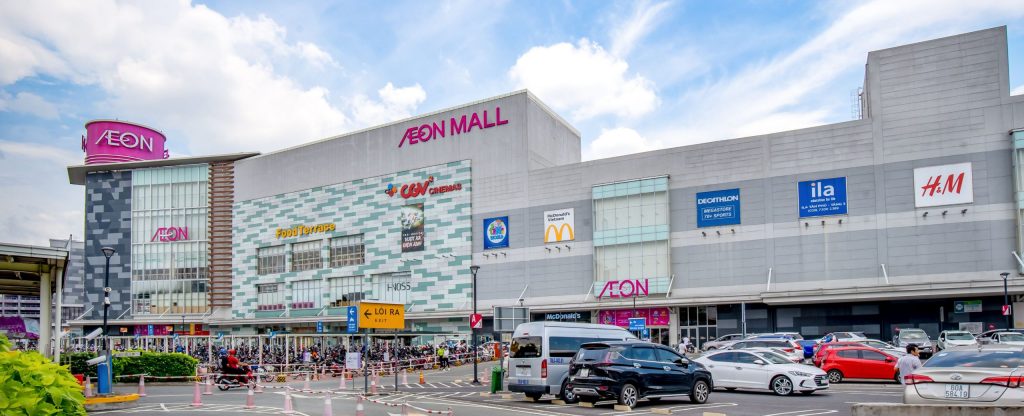
According to Nikkei Asia, Vietnam is known as a market with a favorable perception of Japanese products. Consumers often highly regard and trust goods originating from Japan. One of the most prominent Japanese retailers in Vietnam is Aeon. The conglomerate opened its first shopping mall in 2014. Currently, Aeon has 11 centers nationwide.
“By 2030, Vietnam’s population will reach 110 million,” Mr. Akio Yoshida, President of Aeon, shared at a financial results briefing in mid-April. “The middle class is growing rapidly. As living standards improve, we want to develop in various models and capitalize on the significant growth opportunities for the group.”
Aeon aims to open 180 supermarkets and general merchandise stores in Vietnam by 2030. The current number is 46. The group also plans to launch credit card services through a domestic finance company that Aeon acquired in February. Additionally, Aeon will open its first cinema in Vietnam this year through a joint venture. Aeon’s business value in Vietnam is growing at a double-digit rate annually. Mr. Yoshida stated that annual revenue in this market could reach 500 billion yen by 2030.
Uniqlo is another Japanese retailer rapidly expanding in Vietnam. The brand opened its first store in Vietnam in 2019 and now has 29 stores nationwide. Across Southeast Asia, the fashion brand has 342 stores, with Thailand, Indonesia, and the Philippines each having over 70 stores.
Japanese trading houses are also seeking opportunities in Vietnam. In February, Itochu invested in a car loan company in Thailand, following a previous investment in a life insurance company in the same country. Mr. Yasuhito Kawauchino, Chief Operating Officer of Itochu’s finance and insurance division, indicated that Vietnam is also being considered by Itochu as the next investment destination.
Mr. Nguyen Tuan Anh, program coordinator at the ASEAN-Japan Centre, noted that Japan’s aging population trend is driving its companies to expand into Southeast Asia. He explained that Japan’s population is aging, and the domestic consumer market is nearing saturation. Therefore, many Japanese companies with strong financial resources are seeking new growth drivers abroad.
Even Japanese small and medium-sized enterprises (SMEs) are looking to invest overseas. Last year, about 41% of nearly 1,900 SMEs interested in international business told JETRO that they wanted to open their first overseas base within the next three years. The United States was the most targeted market, with Vietnam ranking fourth and Thailand sixth.
This trend is being supported by Japanese regional financial institutions, which are the main source of funding for small businesses. According to a survey by the Regional Banks Association of Japan with 62 banks, the number of representative offices in Singapore, Thailand, and Vietnam had doubled by April 2023 compared to ten years prior.
The Japan Bank for International Cooperation (JBIC), a policy-based financial institution, launched a program last year to support Japanese regional financial institutions facing difficulties in investing overseas.
Around ten years ago, MUFG – Japan’s largest bank by asset size – began to view Southeast Asia as a crucial region for promoting growth. Mr. Takeshi Asahi, Managing Director of MUFG’s global commercial banking planning division, stated: “Initially, our overseas expansion, including into Southeast Asia, was mainly to follow Japanese companies such as manufacturers and trading firms. The goal was to support their business activities abroad.”
“But then, we started to wonder if we could also tap into the increasing domestic demand along with the economic development of each country.”
Thanks to this approach, MUFG – known as a relatively cautious bank – has rapidly expanded its operations in Southeast Asia. They began investing in non-banking sectors. In 2020, MUFG formed a strategic partnership with Grab – a Singapore-based ride-hailing and food delivery company. Currently, the majority of MUFG’s international commercial banking operations are concentrated in Southeast Asia.
Since around 2010, as labor costs in China increased, Southeast Asia began to be seen as an alternative. The region was no longer just a manufacturing base for Japanese companies but had become a potential consumer market.
According to the Japanese Ministry of Foreign Affairs, as of October 2024, there were 5,856 Japanese companies operating in Thailand, 2,394 in Vietnam, and 2,182 in Indonesia. Recently, there has been a clear shift in the flow of direct investment from Japanese companies into Southeast Asia. The amount of investment in the non-manufacturing sector has surpassed that in the manufacturing sector. By the end of 2023, 55% of the total FDI of Japanese enterprises in the region was in non-manufacturing industries. This marks the fifth consecutive year this has been the case.
“This shift stems from several fundamental factors, including increased domestic consumption, greater technology adoption, rapid urbanization, and increasing access to financial services,” said Mr. Kenichi Shimomura, a Southeast Asia expert at consulting firm Roland Berger’s Singapore office. “Sectors such as e-commerce, fintech, healthcare, and logistics are attracting many investors. In the future, the non-manufacturing sector may attract even more new businesses than the manufacturing sector,” he added.
The trend of shifting to the non-manufacturing sector is evident in Thailand, Vietnam, and Indonesia – based on data from the Bank of Japan. This data records the value of cross-border investment transactions over a 12-month period and is often used to track short-term investment trends, unlike stock data.
Mr. Kenji Kanamoto, Deputy Governor of JBIC, noted that small and medium-sized manufacturing enterprises still account for the majority of overseas investments. This is because large corporations often bring their suppliers to overseas production bases. However, he also stated that the number of SMEs investing in non-manufacturing sectors such as food, beverage, and services in Southeast Asia is increasing significantly.
Mr. Jayant Menon, a senior visiting fellow at the ISEAS-Yusof Ishak Institute, believes that the trend of moving away from traditional manufacturing will continue. He stated that digital goods and services will account for the majority of trade growth in the future. Digitalization will also drive the development of services trade. Japanese companies are not the only ones interested in Southeast Asia. Ms. Azuki Yamaguchi, a research manager for the Asia-Pacific region at JETRO, said that Chinese and South Korean companies are also seeking similar opportunities.
Đề xuất
TCEB Unveils Six New MICE Cities – Expanding Thailand’s Network to 16 Destinations
Rising Investments in Advanced Batteries Drive Global Lithium-Sulfur Battery Market Growth
Rising Investments in Advanced Batteries Drive Global Lithium-Sulfur Battery Market Growth
Network Modernization and High-Speed Connectivity Drive TD-LTE Ecosystem Market Growth
AI and Digital Technologies Open New Growth Avenues in Water Testing and Analysis Market
Increasing Demand for Spectacle-Free Vision Strengthens the Refractive Surgery Devices Market