


Author: admin
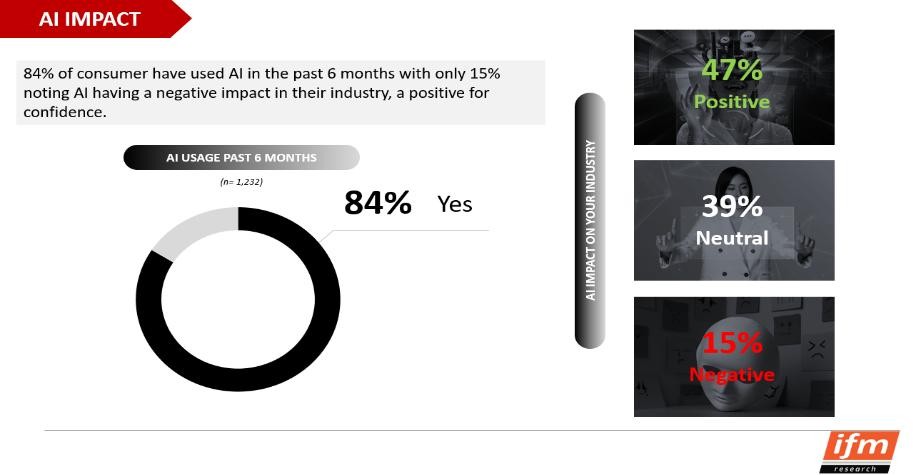
According to our IFM Research, 84% of professionals report using AI in their work over the past six months.
Not testing. Not considering. Using. That’s not experimentation. That’s normalization.
Even more telling: only 15% say AI has had a negative impact on their industry.
Quiet, Not Loud
In technology cycles, adoption often runs parallel with fear.
This time, the gap between usage and anxiety is surprisingly wide. Most businesses are not describing AI as destabilizing.
They’re describing it as useful.
That difference matters. Because usefulness builds trust faster than hype ever could.
If you were expecting dramatic disruption — mass layoffs, overnight restructuring, existential collapse — the data suggests something more subtle.
AI is not detonating industries. It is dissolving inefficiencies.
Marketing teams use it to test copy variations in minutes instead of days. HR screens large applicant pools faster. Finance departments detect irregular transactions automatically. Customer service teams deflect routine inquiries before a human ever intervenes.
None of these are cinematic. All of it is cumulative.
And when cumulative gains scale across departments, the operational math shifts.
Why Fear Hasn’t Dominated
Only 15% reporting negative impact is not trivial. But it is not a majority panic either. Why?
Because for most organizations, AI has entered through side doors, not front gates.
It began as assistance — drafting, summarizing, analyzing. It handled structured, repeatable tasks. It reduced the kind of cognitive load that drains energy without creating differentiation.
When a tool saves two hours a week without threatening identity, resistance is low.
There are industries feeling sharper pressure — content production, certain administrative roles, entry-level analytics. Automation does not distribute impact evenly. But the broader economy appears to be absorbing AI as augmentation rather than replacement.
Confidence emerges not from optimism, but from experience.
Not a Revolution — A Rewiring
The language around AI often implies rupture. But what the IFM data suggests is recalibration.
Inside most companies, AI is not overthrowing systems. It is rewiring them.
Faster reporting. Cleaner forecasting. Quicker iteration. Fewer manual bottlenecks.
And sometimes, that’s how transformation really looks — not loud, not dramatic, but quietly structural.
As one of our Clients in the FMCG sector Noted… “AI is not replacing research, but rather generating efficiencies, to allow us faster more poignant insights, which leads to quicker market impact”
AI hasn’t taken over business. It has settled in.
Sources:
IFM Research, “Consumer Confidence Index C Tet 2026 Spend Report”.
Contact us: Ralf Matthaes, Managing Director, IFM Research
Email: ralf.matthaes@ifmresearch.com
HCMC, Vietnam,
Đề xuất
Retaining Major FDI Players in Technology and Semiconductors
Six Years of EVFTA: From Ambitious Trade Deal to Regional Blueprint
“It CAN’T happen to Me!” How to drive impactful messaging
The Middle-Income Growth Myth
AI Becomes the Operating Brain for Vietnamese Enterprises
Ho Chi Minh City Establishes Venture Capital Fund to Fuel Innovation and Startups